LMArena (Now Arena): How the AI Leaderboard Works and How to Read It
LMArena, now Arena at arena.ai, ranks AI models through blind human votes. Here is how Battle mode works, who leads the October 2026 leaderboards and how to read the scores.
 11 min read
LMArena, now called Arena and found at arena.ai, is a free website that ranks AI models by letting people vote on anonymous answers. You type a prompt, two unnamed models reply, you pick the better reply, and the votes are turned into a public leaderboard. On October 20, 2026, the text leaderboard listed 418 models and 8,900,458 votes, with Google’s Gemini 4 Argon in first place at 1524 points. That lead is marked “Preliminary”, and the rest of this guide explains why that word matters.
LMArena, now Arena (arena.ai), ranks AI models through blind human votes. On October 20, 2026 Gemini 4 Argon led the text board at 1524, but it is marked Preliminary, so read the margin and vote count first.
Summarize this article with:
 ChatGPT
 Perplexity
 Claude
 Grok
We opened the leaderboards, the FAQ and the company’s announcements on October 23, 2026 and dated every number we quote. Scores move almost daily, so treat the tables below as a snapshot and check arena.ai before you pick a model for real work.
From Chatbot Arena to Arena: what changed
The project started as Chatbot Arena, a research experiment run by UC Berkeley researchers, and became LMArena before a company took it over. Arena’s own About page says it formed Arena Intelligence Inc. in 2025 and raised money from Andreessen Horowitz and the University of California. Its January 2026 funding post still used the LMArena name, and the site now carries the plain “Arena” brand. The old name survives in search queries and on Hugging Face, where the original leaderboard space is still published under “lmarena-ai”.
The money has grown fast. Arena announced a $100 million seed round in May 2025, a $150 million Series A on January 6, 2026, and on October 8, 2026 a $200 million Series B at a $3.1 billion valuation co-led by Lightspeed Venture Partners and Khosla Ventures. In that post the company says it has passed $100 million in annualized revenue, a figure we cannot verify independently.
The people behind it
Anastasios Angelopoulos, a Berkeley-trained researcher who co-founded the project, is the CEO. Public company profiles list co-founder Wei-Lin Chiang as CTO, and Berkeley professor Ion Stoica is also named as a founder. Those titles come from third-party profiles, not from Arena’s About page, which does not name executives.
Where the money comes from
Arena says it sustains itself by selling AI evaluations to enterprises, model labs and developers, built on real-world human feedback. Regular visitors pay nothing. In practice, the votes you cast feed a product that AI companies buy, which is worth knowing before you paste anything into the prompt box.
How a Battle works, step by step
Arena’s “How it works” page describes four moves, and the FAQ adds the rules that decide which votes count:
- Type a prompt and choose the right tool, for example text, image or video.
- In Battle mode, two anonymous models answer side by side.
- Vote for the answer that suits you better.
- The model names are revealed, and you can keep chatting or start over.
Only votes cast while the models are still anonymous count toward the official rankings. Side by Side mode, where you pick the models yourself, and Direct mode do not feed the public leaderboard, although Arena still collects the prompts for research. Some contenders appear under codenames because labs use Arena to test unreleased models. A codenamed model only reaches the public board under its real name if it passes the lab’s release criteria and Arena’s leaderboard policy.
Arena turns votes into scores with the Bradley-Terry model, which its FAQ describes as similar to the Elo system used in chess. In Elo, beating a strong opponent earns more than beating a weak one. Bradley-Terry applies the same idea but fits all the votes together instead of updating one match at a time, so every score is recomputed as new votes arrive. The anonymity matters because people tend to favor brands they know. Hiding the names pushes voters to judge the writing, the code or the picture itself.
Free to use, with no published cap
It is free to use, and the FAQ says you may submit as many prompts and votes as you like. The home page opened without a login wall for us, with a Log In button in the sidebar. We did not send a prompt, so we cannot say whether it asks for an account after several chats. If you only want to try AI assistants without registering, our list of free AI tools that work without an account covers the main options.
Free does not mean private
The company is well funded and its methods are published, but your conversations are not private. The FAQ says prompts may be used and shared, including in public research datasets and in private evaluations with model providers, after de-identification. It recommends keeping sensitive information out of your chats. The home page also warns that inputs are processed by third-party AI and answers may be inaccurate.
The Text Arena leaderboard on October 20, 2026
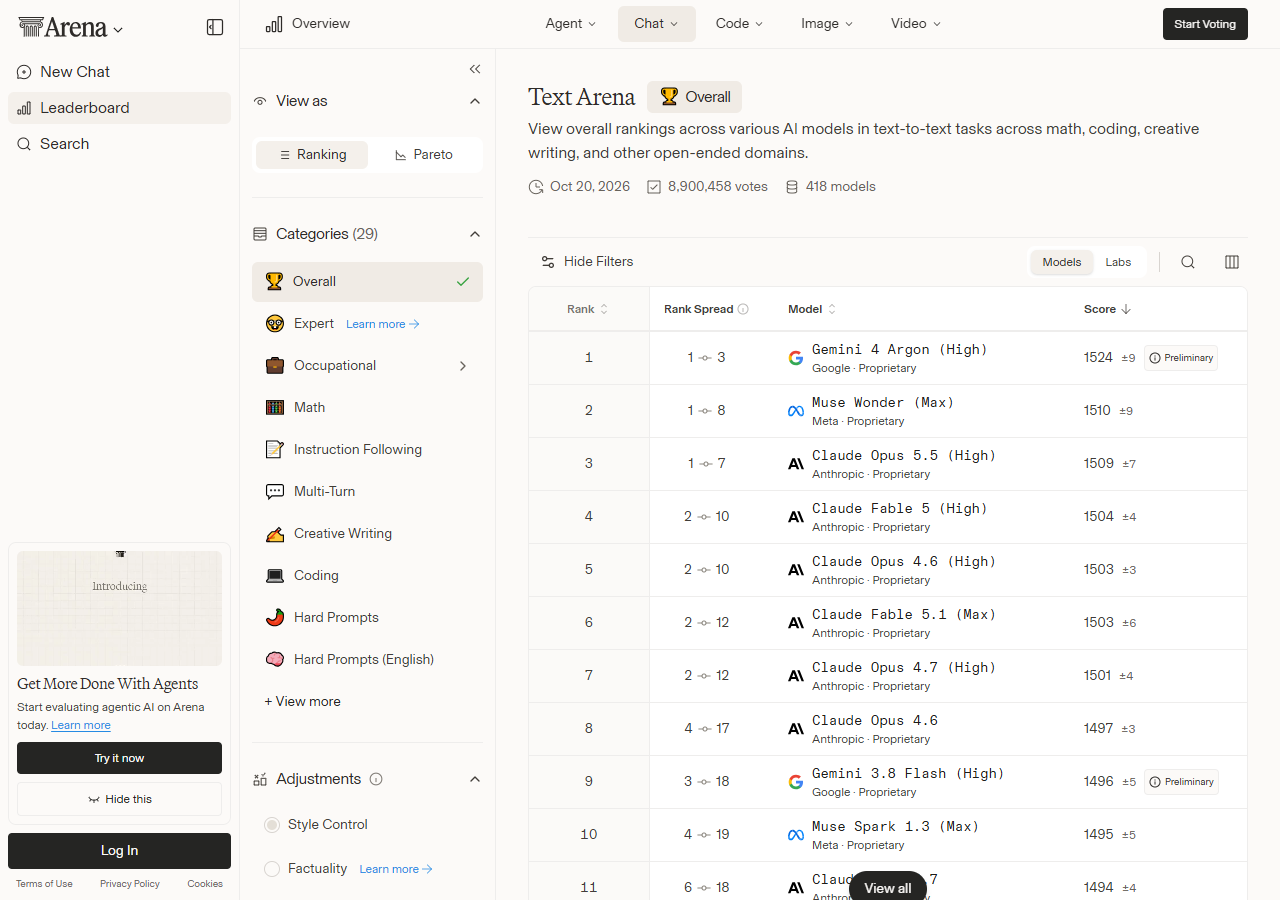
Here are the first ten rows of the default “Overall” view, read on October 23, 2026. The votes column shows how much evidence sits behind each score.
| Rank | Model | Lab | Score | Votes |
|---|---|---|---|---|
| 1 | Gemini 4 Argon (High) | 1524 ±9 (Preliminary) | 4,900 | |
| 2 | Muse Wonder (Max) | Meta | 1510 ±9 | 5,099 |
| 3 | Claude Opus 5.5 (High) | Anthropic | 1509 ±7 | 9,496 |
| 4 | Claude Fable 5 (High) | Anthropic | 1504 ±4 | 43,399 |
| 5 | Claude Opus 4.6 (High) | Anthropic | 1503 ±3 | 82,619 |
| 6 | Claude Fable 5.1 (Max) | Anthropic | 1503 ±6 | 15,623 |
| 7 | Claude Opus 4.7 (High) | Anthropic | 1501 ±4 | 65,131 |
| 8 | Claude Opus 4.6 | Anthropic | 1497 ±3 | 87,372 |
| 9 | Gemini 3.8 Flash (High) | 1496 ±5 | 41,423 | |
| 10 | Muse Spark 1.3 (Max) | Meta | 1495 ±5 | 19,323 |
Six of the top ten are Anthropic models, which is why many people describe the board as Claude-heavy. The first row deserves caution: Gemini 4 Argon has only 4,900 votes, against 82,619 for Claude Opus 4.6 (High), so Arena tags it “Preliminary”. Its 15-point lead over the third row also comes with a margin of ±9, and the intervals nearly touch. A newer model often looks better early, then settles as more votes arrive.
How to read the numbers
- Score: a relative strength, not a percentage. A 1524 means nothing alone, only against the other rows.
- The ± figure: the uncertainty around the score. Two models whose ranges overlap cannot be separated with confidence.
- Rank spread: a range of positions a model could plausibly hold once that uncertainty is counted. Gemini 4 Argon is listed as 1 to 3, and Claude Opus 5.5 (High) as 1 to 7.
- Votes: the more votes, the steadier the score.
- Price columns: the board lists price per million tokens and a median cost per task, so you can see what a rank costs.
That last column changes the picture. On this snapshot, Gemini 3.8 Flash (High) sits ninth at 1496, also tagged Preliminary, for a listed $0.01 per task and $0.75 input and $3.75 output per million tokens, while Claude Opus 5.5 (High) lists $0.09 per task. If two models have overlapping margins, the cheaper one is usually the sensible pick. The board also lets you switch to a Pareto view and apply “Style Control” and “Factuality” adjustments, which reduce the effect of long, nicely formatted answers.
Where each lab stands
The headline rank hides how far the field extends. Here is each lab’s best-placed model on the same text board.
| Lab | Best model on the board | Rank | Score |
|---|---|---|---|
| Gemini 4 Argon (High) | 1 | 1524 ±9 | |
| Meta | Muse Wonder (Max) | 2 | 1510 ±9 |
| Anthropic | Claude Opus 5.5 (High) | 3 | 1509 ±7 |
| OpenAI | GPT-5.6 Sol (xHigh) | 21 | 1484 ±4 |
| Alibaba | Qwen3.8-Max | 23 | 1483 ±5 |
| DeepSeek | DeepSeek-V4.1-Flash-20260910 (Max) | 36 | 1475 ±6 |
| SpaceXAI (Grok) | Grok 4.20 Beta 1 | 39 | 1475 ±5 |
| Mistral | Mistral Large 4 | 112 | 1433 ±7 |
Rank 21 for OpenAI and rank 112 for Mistral do not mean those models are weak. The gap between the 21st and the 36th model is only nine points, so most of the board is a tight pack, and chat preference is just one kind of quality. A lab that tunes for coding, cost or open weights can rank lower here and still be the best fit for your job.
Other arenas: image, video, search and web development
Arena no longer ranks only chat. The site has separate leaderboards for vision, image generation, video generation, search and web development, plus an Agent arena and an Alignment Index launched on October 8, 2026. Each has its own update date, so a model can lead one and trail another.
| Arena | First place | Score | Last updated on the page |
|---|---|---|---|
| Vision (reading images) | Claude Fable 5 (High) | 1309 ±7 | October 19, 2026 |
| Text-to-Image | GPT-Image-2.5 Sunburst (Preliminary) | 1425 ±7 | October 7, 2026 |
| Text-to-Video | Gemini Omni 1.1 Flash | 1516 ±15 | September 21, 2026 |
| Search | GPT-5.6 Sol (xHigh), level with Qwen3.8-Max | 1261 ±6 | October 13, 2026 |
| WebDev | Claude Opus 5.5 (Max) | 1807 | October 22, 2026 |
If you generate video, the Text-to-Video board is a useful filter before you try tools. Our guides to the best AI video generators and to free AI video generators with no sign-up look at what is actually available to buy or try.
How much to trust the ranking
Arena is one of the most widely cited AI leaderboards, and it also has serious critics. A data-labeling company, Surge AI, published a post titled “LMArena is a cancer on AI”, and the question of whether the board can still be trusted comes up regularly on Reddit. The limits are real and worth knowing:
- Who votes: the crowd is self-selected, probably skewed toward tech users and English speakers. Arena does not publish a demographic breakdown that we found.
- Style over substance: voters often prefer confident, polished answers. Style Control exists to limit that bias, but it does not remove it.
- Private testing: labs can test several variants before release. In April 2025, Meta submitted an experimental chat-tuned version of Llama 4 Maverick that differed from the public model, which sparked a debate about transparency.
- Narrow tasks: a short prompt typed into a chat box is not your invoice-processing workflow.
- Moving target: scores shift as votes arrive, and new models start with wide margins.
Use the board to build a shortlist, then test your own prompts. Ten minutes of Battles with the kind of questions you actually ask will tell you more than a one-point gap. Arena’s FAQ also points researchers to anonymized voting data, shared through Hugging Face, for anyone who wants to inspect the votes behind the scores.
Arena versus classic benchmarks
| Method | What it measures | Strength | Weakness |
|---|---|---|---|
| Arena (human votes) | Which answer people prefer in blind duels | Reflects real prompts and real taste | Preference is not accuracy, and the crowd is not neutral |
| MMLU, GPQA | Knowledge and reasoning on fixed questions | Repeatable and cheap to run | Models can be tuned to the test |
| SWE-bench | Fixing real software issues | Close to coding agent work | Covers one job only |
| Your own test | Your tasks | The only result that matches your needs | Takes your time |
Arena itself makes the same point about fixed tests. In its Series B announcement, the company argues that static benchmarks break down once models learn they are being tested, which is part of why it built evaluations around live human and agent activity. Whatever you make of that claim, no single number replaces a trial on your own work. If you are weighing a paid plan, our comparison of ChatGPT free vs Plus shows what you get for the money.
Frequently asked questions
What is LMArena?
LMArena, now simply called Arena (arena.ai), is a website that ranks AI models through blind duels. You compare two anonymous answers, vote for the better one, and the votes produce public leaderboards for text, vision, image, video, search and web development.
How to use LMArena?
Go to arena.ai, type a prompt and keep the Battle mode selected. Read the two anonymous answers, vote, and the model names are revealed. For the rankings, open the Leaderboard section and pick the arena that matches your task, such as Text or Vision.
Is LMArena free?
Yes. Arena is free to use, and the company earns money by selling evaluations to AI labs, enterprises and developers. The FAQ says you can submit as many prompts and votes as you want.
Does LMArena have a limit?
Arena does not publish a prompt cap that we could find, and the FAQ welcomes as many prompts and votes as you like. The FAQ also notes that models are anonymously resampled after each vote, so you may face a different pair even inside the same chat.
Is LMArena AI safe?
It is a legitimate, well-funded company, but conversations can be used in research datasets and shared with model providers after de-identification. Do not enter passwords, personal data or confidential work, and treat the answers as possibly inaccurate.
Who is the CEO of LMArena?
Anastasios Angelopoulos, a co-founder of the project, is listed as CEO in public company profiles, with co-founder Wei-Lin Chiang as CTO. Arena’s own About page does not name its executives.
How does LMArena make money?
By selling AI evaluations built on human feedback to enterprises, model labs and developers. In its October 8, 2026 Series B post, the company says it has passed $100 million in annualized revenue.
Can I trust the Arena leaderboard?
Use it as a shortlist, not a verdict. Check the margin of error, the vote count and the Preliminary tag, remember that votes measure preference rather than accuracy, and test your own prompts before you commit.