Lumo Review 2026: We Tested Proton’s Private AI Assistant
We tested Lumo, Proton's privacy-first AI assistant, for free and without an account on six real tasks. Here is how it compares with ChatGPT, what it costs and where it falls short.
 11 min read
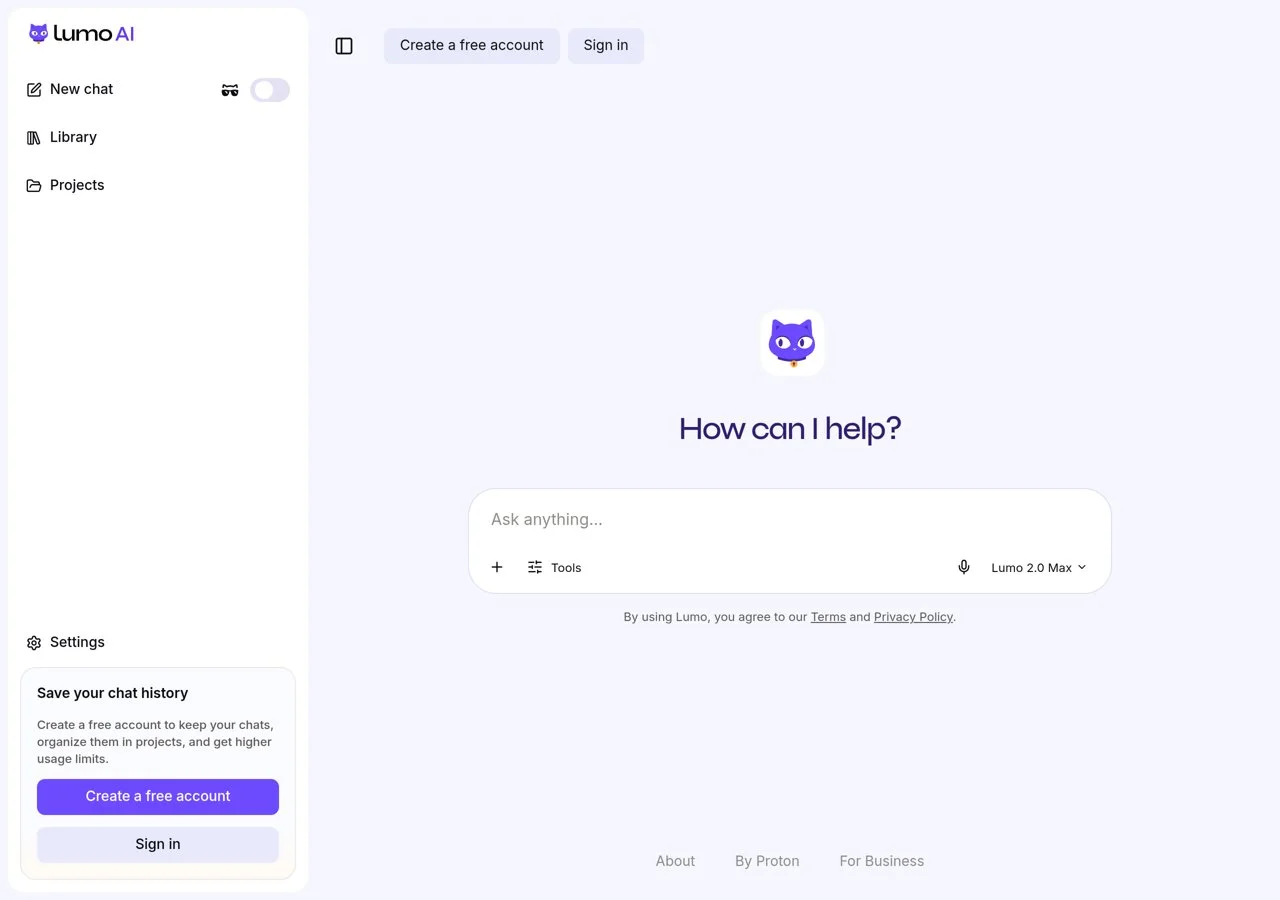
Lumo is Proton’s AI assistant, built by the Swiss company behind Proton Mail and Proton VPN, and its pitch is simple: a chatbot that does not train on your conversations and cannot read your saved chat history. For this Lumo review, we used the free version on October 24, 2026, without an account, on six practical tasks with answers we could check: an email, a logic problem, a web search, a spreadsheet file, an image and a question about Lumo’s own privacy.
Lumo matched ChatGPT on our test tasks without beating it, and it works free with no account. Its edge is privacy: no training on your chats, no ads and encrypted history. Lumo Plus costs $9.99 a month billed yearly (read October 24, 2026).
Summarize this article with:
 ChatGPT
 Perplexity
 Claude
 Grok
Short version: Lumo did as well as ChatGPT on the tasks we gave both of them, not better. Where it stands apart is everything around the answers: no ads, no training on your chats, encrypted history and a guest mode that works without signing up.
Tested on 24 Oct 2026 in free guest mode, no account. This page contains affiliate links.
What Lumo is, and what changed in 2026
Lumo is a general-purpose chatbot, available at lumo.proton.me and as iOS and Android apps. Proton launched it on July 23, 2025, then rebuilt it as Lumo 2.0 on June 30, 2026, adding fast and thinking modes, web search with sources, image analysis and generation, encrypted Projects and user-controlled memory. On October 22, 2026, Proton added Creations, a side canvas for working on documents, code or web pages next to the chat.
The business model is the real difference. Proton makes money from subscriptions, not advertising, and says on its pricing page that your messages are not analyzed to build a profile or used for targeted ads. If you already use Proton’s other apps, our Proton VPN review covers how the wider suite fits together: Lumo follows the same encryption-first approach as Proton Mail and Proton Drive.
Our test: six tasks, one comparison with ChatGPT
We opened lumo.proton.me in a browser while signed out. The site drops you straight into guest mode, with Lumo 2.0 Max selected and web search switched on. Our browser was set to French, so the interface and our prompts were in French; the features and limits are the same in English, as the screenshot above shows.
- Write a short, firm but polite reminder email for a client who has not paid a 450 euro invoice that is 30 days overdue.
- Solve a train timetable problem with three delays to add and subtract.
- Find the current price of Lumo Plus and cite sources.
- Analyze a small CSV file of six months of sales.
- Generate a realistic photo of a desk scene.
- Explain what happens to our conversations and who can read them.
We gave the first two prompts, word for word, to ChatGPT, also signed out. We could not run the same test on Claude or Mistral’s Vibe (the chatbot formerly called Le Chat): Claude requires an account, and Vibe asks you to accept its terms before your first question. For those two, our comparison is based on their published policies, not on a hands-on test.
Three models, even in guest mode
The model menu offers Lumo 2.0 Max for complex tasks, Lumo 2.0 Lite for everyday questions and Apertus 1.5, a fully open Swiss model added in September 2026. You also pick a fast mode or a thinking mode that takes longer for fuller answers. Proton’s help page says all three models are open to free users, but Max has a daily cap, after which Lumo switches to Lite. Proton does not publish the exact cap, and we did not hit it during our session.
Writing and reasoning: on par with ChatGPT
The invoice reminder came back in about 15 seconds: subject line, the amount, a polite assumption that the client simply forgot, an offer to set up a payment plan and a sign-off. The writing was natural. Lumo also added useful advice, such as keeping late-payment penalties for a second reminder and only if your terms of sale allow them. One sentence was off: it said the invoice had not reached the company, when it was the payment that was missing.
ChatGPT’s version was shorter and plainer, with the right wording and no extra advice. Neither was clearly better: ChatGPT got to the point faster, Lumo explained more. On the timetable problem (a train due at 4:08 pm leaves 7 minutes late, makes up 3 minutes, then loses 4 more at a stop), both answered 4:16 pm with the same reasoning, which is correct.
Web search: sources you can check, and an honest caveat
Asked for the current price of Lumo Plus with sources, Lumo first read Proton’s own documentation, then the pricing page, then searched the web. You can watch its reasoning while it works. The answer gave the euro prices, and they were correct: we checked them the same day on Proton’s pricing page. Lumo also pointed out that it had taken the figures from a third-party site because it could not read them on Proton’s page, and told us to double-check. Few chatbots flag the quality of their own sources like that.
One more detail from the visible reasoning: Lumo spotted a suspicious web address in a search result, dressed up as a Proton link, and chose not to cite it. A Sources panel then lists every page it used.
Files and images: accurate and quick
The plus button lets you upload a file from your computer, add one from Proton Drive or sketch a drawing. In guest mode we attached a small CSV of made-up sales (six months of orders and revenue) and asked for total revenue, average order value per month and the month with the strongest growth. Every figure was right: total revenue, a steady average order value and the April peak at plus 25 percent, including the two months that dipped. Lumo even noted that revenue moved with the number of orders, not the basket size. Its only quirk was decorating section titles with emoji.
Image generation is available from the Tools menu without an account. We asked for a steaming coffee cup on a wooden desk next to an open notebook and a pen, in soft morning light, photo style. A realistic square image arrived in under 20 seconds, matching every element of the prompt. Free users get a limited number of images, again without a published number.
Is Lumo truly private?
We asked Lumo directly whether our conversations train a model and who can read them. Its answer matched Proton’s published commitments: no training on conversations, no chat logs, and saved history protected by zero-access encryption that only the user can decrypt on their device. The code is open source, so outside experts can check those claims.
Lumo also added a nuance that marketing pages tend to skip: encryption protects stored history, but each message has to be processed on Proton’s servers to generate a reply. It said plainly that it was repeating Proton’s claims and had no independent audit to point to. Two findings from our session complete the picture. Guest mode keeps nothing between visits: when we came back that evening, our earlier chats were gone. And ghost mode, which deletes a chat as soon as you close it, is greyed out without an account, since it is meant for signed-in users whose history is otherwise saved.
Why it matters: in a survey Proton published on September 24, 2026, covering 4,014 chatbot users in the US, UK, France and Germany, 66% said they had discussed at least one sensitive topic with an AI chatbot, and 42% had little or no trust in AI companies to protect that information. In the US, 65.3% worried more about ad profiling than about model training (57.6%). Proton sells a private chatbot, so treat the study as a signal rather than proof (read Proton’s survey).
Lumo vs ChatGPT, Claude and Vibe
On ability alone, our test does not show Lumo beating ChatGPT. The real gap is in the rules, summarized below from each company’s official pages as of October 2026.
| Question | Lumo | ChatGPT | Claude | Vibe (Mistral) |
|---|---|---|---|---|
| Works without an account | Yes (guest mode) | Yes | No | Terms must be accepted first; not tested |
| Trains on your chats by default | No, never per Proton | Yes for Free, Plus and Pro; you can opt out | Only if you opt in | Yes for individual accounts; you can opt out |
| Ephemeral chats | Ghost mode (signed in) | Temporary Chat, copy kept up to 30 days | Incognito chats | Not verified |
| Ads | None | Being tested on Free and Go | None announced | None announced |
| Our test result | Correct, detailed, one clumsy sentence | Correct, more concise | Not tested | Not tested |
Signed-out ChatGPT says so at the bottom of the page: chats may be reviewed and used to improve its models. You can opt out in the settings, and our guide to using ChatGPT without logging in covers what the signed-out version can do. Anthropic only trains Claude on consumer chats when users agree, and keeps that data for up to five years if they do.
Try Lumo
A free AI assistant with no ads and no training on your chats
Guest mode needs no account. Lumo Plus comes with a 30-day money-back guarantee.
See Lumo plansAffiliate link: we may earn a commission at no extra cost to you. Prices checked on October 24, 2026; confirm on the checkout page.
How much does Lumo cost?
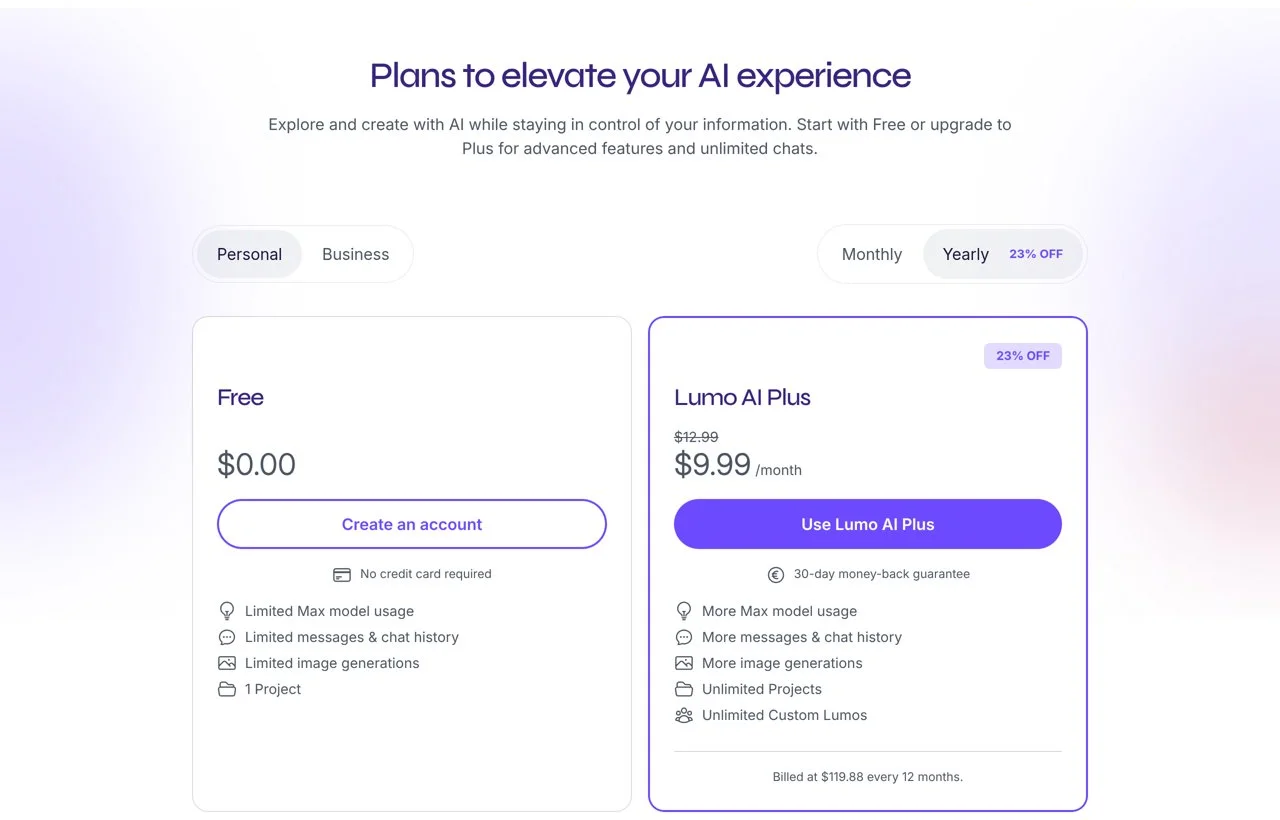
Guest mode and the free plan cost nothing and need no credit card. A free account adds saved history and one Project. Lumo Plus costs $9.99 a month billed yearly ($119.88 every 12 months), against a $12.99 monthly reference price shown on the same page. That “23% off” label simply reflects paying for the year, not a special promotion. Lumo Plus can also be added to an existing Proton plan.
| Plan | Price | What you get |
|---|---|---|
| Guest (no account) | $0 | Limited use, no history kept between visits, no ghost mode |
| Free account | $0 | Limited Max use, limited messages and history, limited images, 1 Project |
| Lumo Plus | $9.99 a month billed yearly ($119.88) | More Max use, more messages, history and images, unlimited Projects and Custom Lumos, multiple large files |
For context, that puts Lumo Plus in the same range as the big chatbot subscriptions; our ChatGPT Free vs Plus comparison breaks down what OpenAI charges. As of October 24, 2026, Proton has not announced a Black Friday discount on Lumo: its sale starting October 26 covers VPN, Mail, Drive, Pass and Unlimited.
The downsides we found
- Not smarter than ChatGPT on our tasks: equal on the logic problem, different but not better on writing.
- Vague free limits: Proton says “limited” without giving message or image counts.
- Reasoning shown in English, even when the chat is in another language.
- Ghost mode needs an account, and guest mode keeps no history at all.
- Emoji in some formatted answers, which you will want to strip before pasting.
- Privacy you partly have to trust: the code is open, but server-side processing still relies on Proton’s word.
Our recommendation
Lumo is a good fit if you want an everyday assistant for personal questions, work documents and drafts without feeding a model or an ad profile. Start in guest mode or with a free account: our test shows that is enough to judge it. Lumo Plus makes sense if you hit the limits or want long, encrypted history, especially if you already pay for Proton. If raw power or a large plugin ecosystem matters most, ChatGPT and Claude still offer more, and our list of free AI tools with no sign-up has other options. Proton’s getting started guide lists every feature and limit.
Our verdict
As capable as ChatGPT in our test, far more careful with your data
Try it free first; upgrade only if the limits get in your way. Lumo Plus is $9.99 a month billed yearly.
Try Lumo for freeAffiliate link: we may earn a commission at no extra cost to you.
Frequently asked questions
Is Lumo a good AI?
In our test it was. Lumo wrote a natural email, solved a logic problem correctly, analyzed a CSV file without errors, cited its web sources and generated a realistic image in under 20 seconds. It matched ChatGPT on the tasks we gave both, without beating it.
Is Lumo truly private?
Proton says Lumo never trains on conversations, keeps no chat logs and stores history with zero-access encryption, and its code is open source. Messages are still processed on Proton’s servers to produce replies, so you are trusting Proton for that step.
What model does Lumo use?
The model picker offers Lumo 2.0 Max, Lumo 2.0 Lite and Apertus 1.5, a fully open Swiss model. Max is the default; free users have a daily Max limit, after which Lumo switches to Lite.
Is Lumo free?
Yes. You can use it in guest mode without an account, or with a free Proton account to keep history. Lumo Plus costs $9.99 a month billed yearly as of October 24, 2026.
What are the key differences between Proton Lumo and ChatGPT?
Both answered our shared prompts correctly. The differences are in the rules: ChatGPT may train on Free, Plus and Pro chats unless you opt out and is testing ads on Free and Go, while Lumo never trains on chats, shows no ads and encrypts saved history.