Eleven v4 audio tags, IPA and dialogue: how to write for it
How to steer the Eleven v4 voice: audio tags in square brackets, delivery cues, IPA phonetics, pauses without SSML and multi-speaker dialogue, based on the official docs.
 7 min read
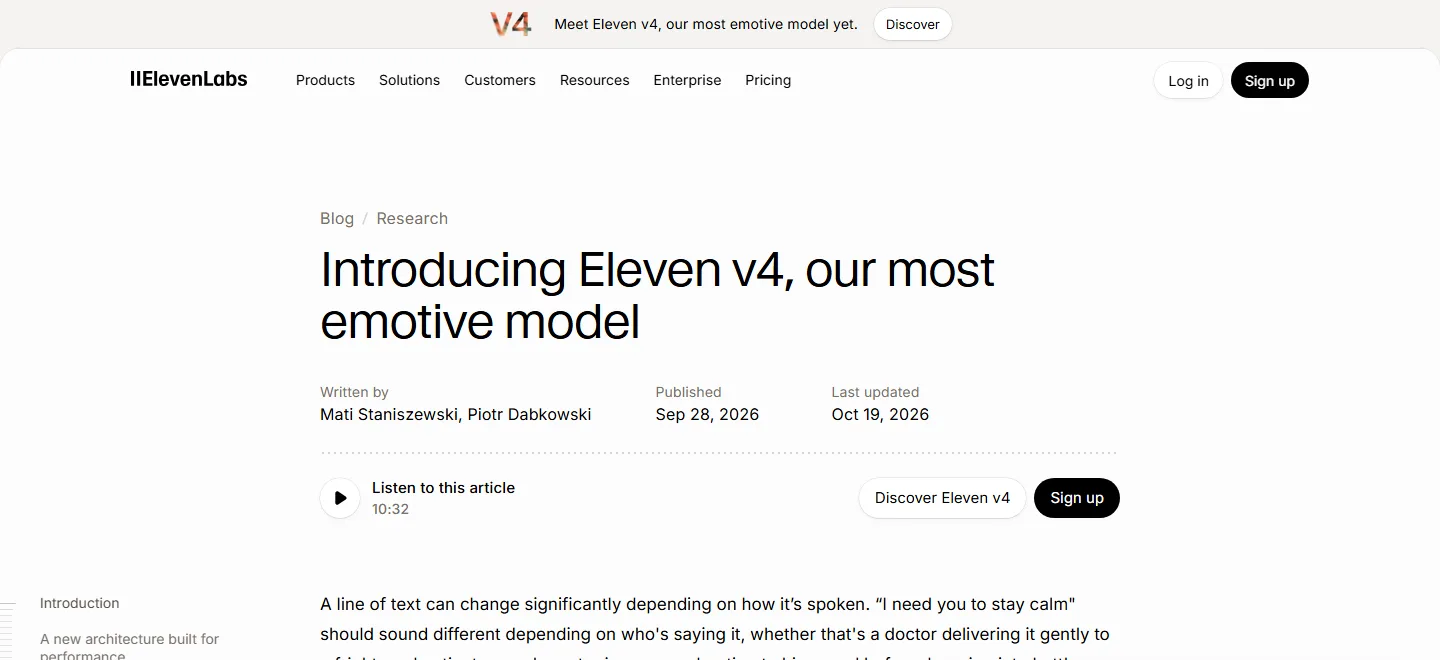
With Eleven v4, the voice you get depends as much on the text you paste as on the model. ElevenLabs says so in its own documentation: text structure strongly influences the output. This how-to gathers what the official docs explain about audio tags, delivery cues, IPA phonetics, pauses and multi-speaker dialogue, with sample scripts you can adapt. Prices and figures were read on the official pages on October 25, 2026.
To steer Eleven v4, put emotions in square brackets, describe the voice rather than an action and fix hard names with IPA. Try a short sample on ElevenLabs before picking a plan.
Summarize this article with:
 ChatGPT
 Perplexity
 Claude
 Grok
Eleven v4 is the text-to-speech model ElevenLabs launched on September 28, 2026, with a Turbo variant for real-time agents. For the general picture (languages, cloning, limits), see our ElevenLabs review. Here we assume you have picked the model and want an expressive voice out of it.
Read on official ElevenLabs pages on October 25, 2026. This page contains partner links.
In short
To steer Eleven v4, put emotions in square brackets (such as [whispers] or [laughs]), describe the voice rather than an action, write hard words in IPA between slashes, and pace with ellipses, because SSML is not supported. For dialogue, label lines Speaker 1 and Speaker 2 and give each its own voice. Test a short passage before running a long text.
What audio tags are and how to place them
An audio tag is a word or short phrase in square brackets, written straight into the script, that tells the model how to say a line or which sound to make. According to ElevenLabs’ docs it can go before or after the text it modifies: “[whispers]” ahead of a sentence, or “This is hard. [sighs]” after it.
| Family | Examples listed in the docs | Worth knowing |
|---|---|---|
| Voice and reactions | [laughs], [laughs harder], [starts laughing], [whispers], [sighs], [exhales], [sarcastic], [curious], [excited], [crying], [snorts], [mischievously] | Most reliable when the tag fits the voice’s character |
| Sound effects | [gunshot], [applause], [clapping], [explosion], [swallows], [gulps] | May be read as a sound rather than a cue |
| Experimental | [strong X accent] (replace X with the accent), [sings], [woo] | Results vary by voice, says the vendor |
The announcement post adds ambience examples such as [light rain] and [phone buzzing]. The list is open: tags are free text, and the docs note that exact spelling can vary (you will also see [whispering] or [shouting]). Expect some trial and error for each voice.
Describe the voice, not a gesture
Eleven v4 also accepts natural-language direction in brackets. The docs show examples like “[Low, steady voice, restrained urgency]” or “[Gentle laugh, then sincere]”. The vendor’s advice is to write tags that describe the quality of the voice you want, such as “[low, gravelly voice]”, instead of cues that could be read out as sounds.
The docs advise against tags that describe a physical action unrelated to voice, such as [standing], [grinning], [pacing] or [music], and against pairing a playful tag with a serious voice: a [giggles] on a deep narrator voice may sound unnatural.
Punctuation, pauses and speed
Without any tag, the model already reads rhythm in the text. Per the docs, ellipses add pauses and weight, capital letters add emphasis, and standard punctuation sets the cadence. The official example: “It was a VERY long day [sigh] … nobody listens anymore.”
One point for people coming from other tools: SSML is not supported in Eleven v4 or v3, so the break tag does nothing. Use ellipses, tags or shorter sentences. The speed setting runs from 0.7 to 1.2 (default 1.0) and extreme values can hurt quality, according to the docs. A separate help page says the Style and Speed sliders are not available for Eleven v4, so check what your interface shows for the voice you picked.
Hard words and brand names: IPA phonetics
When a brand, a proper noun or a technical term is mispronounced, Eleven v4 lets you force the pronunciation with the International Phonetic Alphabet. Write the transcription between two forward slashes inside the text. The docs give a sentence containing the word “biochemistry” transcribed between slashes, using the eleven_v4 model. The rules to keep in mind:
- use standard IPA and include stress marks (ˈ and ˌ);
- apply it only to the words that need it;
- wrap the string in double quotes when you send it through the API;
- several transcriptions can sit in one sentence;
- results can still vary by voice and phrase, so generate more than once and keep the best take.
The older XML phoneme tags are for v2 models only (eleven_flash_v2), not Eleven v4.
Writing a multi-speaker dialogue
Dialogue is one of the features ElevenLabs highlights: lines react to the scene’s context instead of being stitched together. The docs say v4 handles multi-voice prompts well, with a simple method: label lines “Speaker 1:” and “Speaker 2:”, assign a distinct voice from your library to each, and place tags inside the lines, including mid-line for interruptions or overlaps. For an interruption, the docs put a dash in front of the cut-off line.
Speaker 1: [curious] Did you see the new version?
Speaker 2: [excited] Yes! It finally handles laughs [laughs] and whispers.
Speaker 1: [whispers] Then we try it tonight...
This is an illustration script written for this page, not a recording: we did not have the model read it. On the API side, ElevenLabs says dialogue goes through “Create dialogue” and “Stream dialogue”, and single-voice generation through “Create speech” and “Stream speech” with the eleven_v4 model ID.
A five-step method for long texts
- Pick the voice first. Third-party guides we read stress this: a voice that already fits the role is a better starting point than any tag.
- Write the way people speak. Short sentences, clear emotion, careful punctuation.
- Add few tags. One tag per intention is enough; piling them up mixes the signals.
- Test a passage of three to five sentences. Check proper nouns and fix the ones that snag with IPA.
- Generate several takes and keep the best. The docs admit output can vary from one generation to the next.
On volume, the documented limit is 10,000 characters per request, about ten minutes of audio on the models page. For an audiobook or a long video, split by chapter and keep the same voice settings from one chunk to the next. The announcement says request stitching for long content is significantly more reliable in v4.
What it costs to experiment
The free plan gives 10,000 credits a month with no commercial license and no voice cloning. Starter is $6 a month (a $1 first-month promotion was shown until November 1 on the pricing page) with 30,000 credits, the commercial license and instant cloning. Creator is $22 a month for 121,000 credits. Two caveats: the official pages we read do not confirm that Eleven v4 is available on the free plan, and ElevenLabs does not publish the credit cost per character for v4. Generate a short sample and check what it uses in your account.
Our recommendation: open a free account, paste a paragraph of your own script with one or two tags, and listen before you pick a plan.
Try ElevenLabsFrequently asked questions
What is an audio tag in Eleven v4?
A word or short phrase in square brackets, like [whispers] or [laughs], placed in the script to set emotion, delivery or a sound effect. It can go before or after the passage it applies to.
Does Eleven v4 support SSML pauses?
No. SSML, including the break tag, is not supported. Use ellipses, tags or sentence structure to create pauses.
How do I fix the pronunciation of a brand name?
Write its IPA transcription between forward slashes, with stress marks, for that word only. Test with your voice, since results can vary.
How do I make two characters talk?
Label the lines Speaker 1 and Speaker 2, give each a different voice and put tags inside the lines. Through the API, use Create dialogue or Stream dialogue.
Is Eleven v4 free to try?
The free plan offers 10,000 credits a month, but the official pages we read do not confirm that Eleven v4 is included. Check the model list in your account.
Sources: ElevenLabs text-to-speech best practices and the official Eleven v4 announcement, read on October 25, 2026.